CONNECTING GLOBAL INDUSTRY WITH JAPAN
Contact
In manufacturing monopiles for offshore wind power, heavy steel plate is formed into a cylinder and the plates are then welded together to a high degree of accuracy. Bevelling — machining the plate edges to the right angle and shape before welding — is therefore a critical process.
The plate edges had previously been prepared by flame cutting, but thermal cutting tends to leave a rough surface and to produce variation in shape and dimensions. To mass-produce large-diameter, thick-walled monopiles at high quality, equipment that could machine the bevel to a more consistent accuracy was needed.
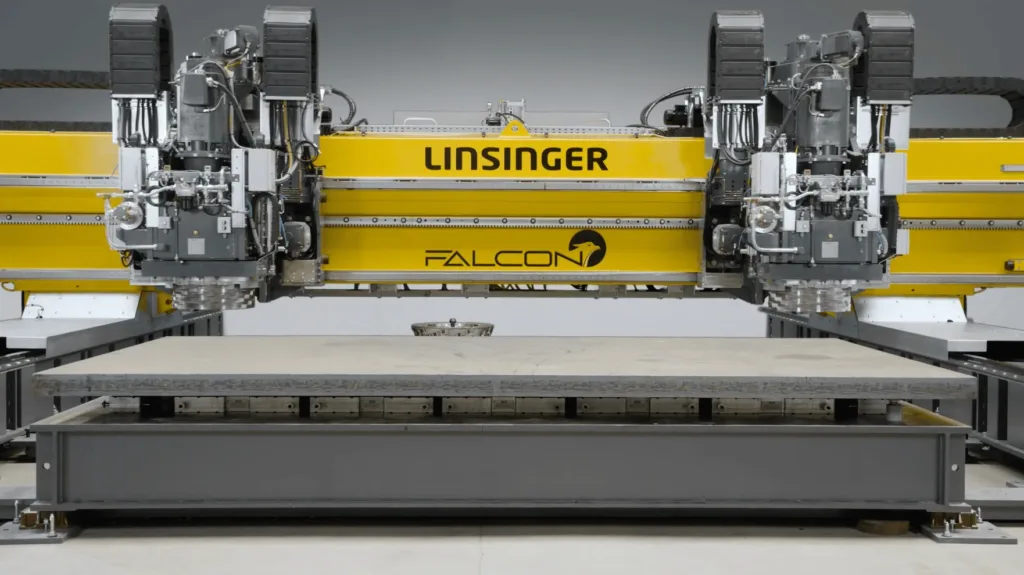
For this we proposed LINSINGER's plate edge milling technology. It removes material from the plate edge by cutting, and can form V, X, Y and J bevels and other shapes to a high accuracy according to the welding requirements.
The LINSINGER FALCON series in particular machines all four edges of heavy plate accurately and at high speed, which suits weld preparation for offshore wind and large steel structures. Producing an angled edge by flame cutting is certainly possible, but with the LINSINGER machine the customer can consistently produce a smoother bevel face with better dimensional repeatability.
We took a detailed account of the plate thickness, dimensions, welding method and required bevel shapes for the monopiles the customer manufactures, and set out the machining conditions needed. We passed this on to LINSINGER and worked through the equipment specification and the machining conditions with them.
Rather than simply delivering a machine, we supported the project throughout — technical coordination with the manufacturer, installation and trial running, and follow-up after start-up — so that the machine would work reliably once built into the actual production line.
Milling has made it possible to finish the plate edges at a consistent angle and shape, improving the quality of weld preparation. With less variation in the bevel, the welding conditions when two plates are brought together are also more stable, which leads to high-quality welds.
Fast, repeatable bevelling also contributes to the productivity needed for monopile series production. It has become one of the key machining processes supporting monopile manufacturing for offshore wind in Japan.
Start with a conversation about your potential in the Japanese market.
You do not need to have a distributor in place. We can support you from initial market research and your first visit to Japan.
UTATA PROGRESS Co., Ltd. (hereinafter “we”, “us”, or “our”) sets out below its policy on the handling of personal information on the website it operates (hereinafter “this site”).
We collect, by lawful and fair means, the name, company or organisation name, department or title, email address, telephone number, enquiry details, and other information provided by the individual, to the extent necessary to respond to enquiries and conduct our business.
We use the personal information we collect for the following purposes.
Any change to these purposes will be made only within a scope reasonably related to the original purpose, and the revised purposes will be published on this site or by other means.
We do not provide personal data to third parties without the individual’s consent, except in the following cases.
Where technical consultation or the evaluation of equipment requires sharing information with Aichi Sangyo Co., Ltd., the manufacturers we represent, or other related parties, we will identify the information to be shared, the recipient, and the purpose, and obtain consent or take other steps as required by law.
Information submitted through the enquiry form is received and stored principally on mail servers located in Japan. Japan has been recognised by the European Commission as providing an adequate level of protection for personal data. However, where Google Analytics, Cloudflare Turnstile, or other external services are used, IP addresses, cookies and other online identifiers, and device or browser information may be processed outside Japan.
Where we provide information to related parties outside Japan to the extent necessary for our business, we will inform the individual of the data protection regime in the recipient’s country and other information required by law, obtain prior consent where applicable, and handle the data in accordance with the governing law.
We may entrust the handling of personal information to external service providers to the extent necessary to achieve the stated purposes. In such cases we select the provider appropriately, conclude the necessary agreements, and exercise appropriate supervision over their handling of personal information.
We implement organisational, personnel, physical, and technical security measures to prevent the leakage, loss, or damage of personal data, and manage personal data appropriately. Details of these measures will be provided on request, in accordance with the law.
Entries submitted through the enquiry form are not stored on this site’s server; they are sent by email to the responsible member of our staff. We retain personal information only for as long as necessary to achieve the stated purposes and, except where retention is required by law, delete or dispose of it appropriately once retention is no longer necessary.
Where a matter concludes with the enquiry alone, we retain the personal information for approximately two years from the date the matter was closed, after which it is deleted or disposed of appropriately. Information relating to business discussions, contracts, transactions, or statutory retention obligations is kept for the period required for contract performance, dispute resolution, tax and accounting, or other legal requirements.
Individuals may request notification of the purpose of use, disclosure, correction, addition or deletion, suspension of use or erasure, cessation of provision to third parties, or disclosure of records of provision to third parties, in respect of their personal data held by us.
To make a request, please contact us using the details at the end of this policy. We will verify that you are the individual concerned or an authorised representative and respond in accordance with the law. Where the law prevents us from granting a request, we will explain this and the reasons. For requests under the GDPR from individuals located in the EU or EEA, we will respond without undue delay and in principle within one month of receipt. Where necessary because of the complexity or number of requests, we may extend that period in accordance with the law, having notified you of the reasons.
This site may use cookies and similar technologies to understand how the site is used, improve convenience, and maintain security. Users may disable cookies through their browser settings, though some features of this site may then be unavailable.
Where the user consents, this site may use Google Analytics, provided by Google LLC. Google Analytics uses cookies and similar technologies, and information on pages viewed, the date and time of access, the operating environment, approximate location, device and browser details, IP addresses, and other online identifiers may be transmitted to Google. We use this information to understand and improve how this site is used.
The event data retention period in Google Analytics is set to 14 months. Individual event data older than this period is deleted in accordance with Google’s specifications.
Where analytics or other external services are used, we will state on this site which services are used, what information is collected, for what purpose, and how to opt out. Analytics cookies are enabled only with consent. Users may refuse, withdraw, or change their consent at any time via the cookie consent banner or “Cookie Settings” in the footer of this site.
This site may use Cloudflare Turnstile, provided by Cloudflare, Inc., to prevent spam and other misuse of the enquiry form. Its use may involve the transmission of IP addresses and information about the device and browser to Cloudflare. For details of how Cloudflare handles such information, please refer to Cloudflare’s privacy policy.
We may revise this policy in response to changes in law, changes to our services, or as otherwise necessary. Where a material change is made, we will give clear notice on this site. The revised policy takes effect when it is published on this site.
This policy is governed by and construed in accordance with the laws of Japan. Any dispute arising in relation to this policy or the handling of personal information shall be submitted to the exclusive jurisdiction of the Osaka District Court as the court of first instance. This provision does not limit any right or remedy available to the individual under the GDPR or other applicable law.
Where the GDPR (EU General Data Protection Regulation) applies in connection with the provision of services to individuals located in the EU or EEA, we handle personal data as set out below.
UTATA PROGRESS Co., Ltd. (UTATAプログレス株式会社) is the controller of personal data. We can be contacted via the enquiry form on this site.
Entries submitted through the enquiry form are not stored on this site’s server; they are sent by email to the responsible member of our staff. Email is received and stored on servers located in Japan. Where a matter concludes with the enquiry alone, the data is retained for approximately two years from the date the matter was closed and then deleted. Where the matter proceeds to business discussions or a contract, it is retained for the period necessary for contract performance and statutory retention obligations.
Information collected through the enquiry form is stored and processed principally in Japan. Japan is a country recognised by the European Commission as providing an adequate level of protection for personal data (European Commission decision of 23 January 2019). However, the use of Google Analytics, Cloudflare Turnstile, and other external services may involve the processing of IP addresses, cookies and other online identifiers, and device or browser information outside Japan. Should it become necessary to provide data to related parties outside Japan, we will inform the individual in advance and put appropriate safeguards in place.
Individuals have the following rights in respect of their personal data processed by us.
To exercise these rights, please submit a request through the enquiry form on this site. We will respond without undue delay and in principle within one month of receipt. Where necessary because of the complexity or number of requests, we may extend that period in accordance with the GDPR, having notified you of the reasons. Consent relating to cookies may be withdrawn or changed at any time via “Cookie Settings” in the footer of this site.
Individuals have the right to lodge a complaint about our handling of personal data with the data protection supervisory authority in their country of residence or place of work (Article 77). A complaint may also be made to the Personal Information Protection Commission of Japan.
Completing the enquiry form is voluntary. However, if the required fields are not completed, we will be unable to respond to your enquiry. We do not carry out automated decision-making or profiling based solely on personal data.
For enquiries about this policy or the handling of personal information, please contact us through the enquiry form on this site.